BlogFAQs
The State of AI in the Financial Services Industry
AI in finance has moved past pilots. See where it's deployed across the sector, and why citations, MNPI controls, and proven ROI now gate adoption.
AI in finance has moved well past the pilot stage. Rogo alone now runs inside more than 300 institutions and reaches over 40,000 financial professionals every day, including four of the ten largest banks in the world. Across the sector, 81% of surveyed firms have adopted AI at some level, and 40% report advanced adoption at the scaling or transforming stages.
What has changed is not whether firms are adopting AI but what they now ask of it. The early question was productivity and how much faster a team can work. The question now sits at the level of the business: what this means for the roles people perform, and how a firm stays differentiated when intelligence itself is becoming commoditized.
This article covers where AI is being applied across financial services, what a regulated financial institution requires before any output reaches a client, and how a rollout is run so adoption holds. It also takes up the question that increasingly separates one firm from another: who owns the intelligence a firm builds as it works.
How the question changed: from productivity to differentiation
A productivity argument shaped the first wave of AI adoption. Firms asked how much time a tool could return on drafting, research, and data gathering, and the answer was strong enough to justify a pilot at nearly every institution. That question is largely settled.
The question leaders ask now is broader. As frontier models improve, their ability to execute a given task well converges, and execution stops being where advantage lives. A firm that can produce a competent model or a clean deck with AI is not distinguishable from its competitors, because they can do the same.
What remains differentiated is what a firm encodes: its house standards, its precedents, the judgment its strongest practitioners apply, and the reasoning behind decisions that were never written down anywhere. The buying question follows from that. It is no longer which model performs best this quarter, but who can help a firm embed its own edge into whatever AI tools it uses.
Rogo Intelligence is built for that job. It is a firm's context layer: it sits between the knowledge a firm generates and the AI systems that use it, and it holds the firm's standards, precedents, and the reasoning behind its decisions as structured data the firm owns. Encoding an edge is what turns that knowledge from something individuals carry into something the institution keeps.
People also move between roles and firms, and what they know moves with them. A firm that can seed every new joiner with the encoded expertise of its best people keeps that knowledge inside the institution, and the advantage compounds over time.
Where AI is being applied across financial services
AI adoption has settled into two layers. The first covers operational and risk functions where machine learning has run quietly for years. These use cases range from fraud detection and credit analysis to compliance monitoring and customer service. They have been embedded long enough that most institutions treat them as table stakes rather than innovation.
The second layer covers front-office deal work, where purpose-built finance AI earns its place. The work now running through AI includes earnings and transcript synthesis, public comps and precedent transactions, market mapping, CIM and data-room review, IC memo drafting, and board materials. Each is citation-heavy, time-pressured, and central to how deals get done. Rogo covers this range of work through Felix, its autonomous AI agent, which researches companies, builds financial models, and drafts the deliverables that go in front of clients.
Different roles draw different value from the same platform. Associates and VPs gain throughput on research and model-building, plus first drafts worth iterating on. Managing directors can self-serve in Rogo, asking for an answer by email or running a sensitivity analysis on demand rather than routing the request through a junior team.
Rogo also connects to the data room through VDR providers, including but not limited to SS&C Intralinks, and keeps it in sync, so the entire deal context sits in one place alongside the firm's precedents, its enterprise integrations, and email. Agents can then be deployed to run components of the process rather than isolated tasks.
The time returned is substantial. Tasks that consumed two hours come back in about ten minutes, and work that ran three to four days returns in roughly fifteen minutes. Sector projections point in the same direction: the top 14 global investment banks can raise front-office productivity by as much as 27% to 35% using generative AI, worth roughly $3.5 million in additional revenue per front-office employee.
Hours saved is where most firms start, and it is the floor rather than the whole return. As AI moves from single tasks toward whole workflows and eventually entire transactions, the gain shows up in the topline: mandates won, deals advanced, and clients served that the old economics could not reach.
AI in finance acts as a revenue-generating technology. When the cost of executing a deal falls, mandates too small to be worth a bank's time become economical. And the investment in AI is easy to size: how many incremental mandates, at the firm's average fee, would cover the entire AI budget. For most franchises, it is a handful of deals, which turns the question into whether a team can use AI to win three or four more deals a year.
Monitoring is a different kind of work, running continuously rather than on request. Scheduled agents track M&A activity, earnings reactions, and material events across the companies and sectors a firm follows, then deliver alerts on their own schedule without anyone opening the platform. For a team following dozens of names, that removes hours of manual scanning each week.
What secure AI deployment requires at a regulated financial institution
Deploying AI inside a regulated financial institution turns on three separate tests. The first is whether an output can be verified at all. The second is whether the platform meets the firm's data-sensitivity and regulatory requirements. The third is whether it fits the systems deal teams already work in.
Citations and auditability of data
Adoption in finance is gated less by model capability than by whether an output can be verified. A valuation nobody can trace cannot be used at all, however good it is.
Finance sets a specific bar for this. Every number on a slide has to be traceable to its source. Every cell in a model needs a comment, and every claim needs to link back to a filing, a transcript, or a data feed.
Meeting that bar is what lets an output go straight to a client or an investment committee. Without it, every figure has to be checked by hand, and the checking eats up the time the tool saved.
Rogo builds deep-linked citations into every output. A chat answer, an Excel cell, or a PowerPoint slide links back to its originating source: a specific page of a filing, a line in a transcript, an investor presentation, a prior deal document, or an exact row from a connected data feed. Figures drawn from structured data providers are flagged as high fidelity, so reviewers can see the provenance at a glance.
MNPI, data separation, and compliance
At a regulated financial institution, several requirements are non-negotiable before an evaluation begins. Material non-public information (MNPI) has to be protected. Competing deal teams need isolated environments so one client's data never touches another's. Permissioning, data residency controls, and a commitment to no training on firm data all sit on the required list.
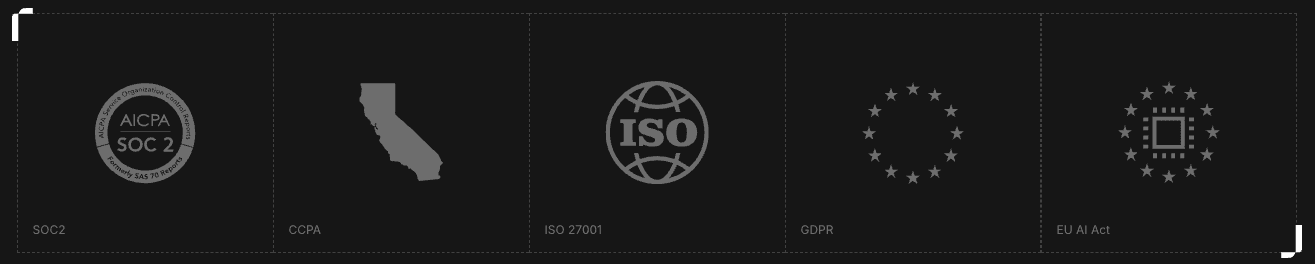
Rogo is built to clear these gates. It operates within a firm's own security perimeter with isolated environments, and it logically separates MNPI from public information inside its institutional memory. On the compliance side it holds SOC 2, ISO 27001, GDPR, BYOK, and SCIM, plus externally validated EU AI Act compliance.
Security is tested continuously rather than annually. Sisyphus, Rogo's autonomous security agent, runs offensive penetration testing once or twice a day across three phases: pre-recon, offensive testing, and automated remediation. One week after Rogo's most recent external penetration test wrapped up, Sisyphus found 18 additional exploitable issues in a single afternoon, and all 18 were fixed the same day.
Integration across fragmented finance systems
Fragmentation is the third test, and it shows up in the mechanics of ordinary work. A typical deal team downloads files from a data room, uploads them to a separate analysis tool, runs the work, exports the results, and reassembles everything by hand before it reaches the client. None of these systems talk to each other, and every hand-off is a point where a stale number or a broken link can pass through unnoticed.
Felix collapses those seams into one platform. It lives natively in the web app, in Microsoft Excel, in email, and on iOS. This enables research, modeling, drafting, and monitoring to happen in the same place.
Felix routes each task to the right sources on its own. Those span company filings, investor presentations, consensus estimates, earnings transcripts, prior deal materials, connected structured data providers, and the firm's own systems including SharePoint and Salesforce, with live data-room sync on top. Nobody has to leave the workflow to pull data.
Who owns the intelligence a firm builds
Every firm already runs systems meant to hold what it knows. The CRM logs relationships, the data room organizes transactions, the drive stores documents, and the knowledge base holds static reference material. Each captures a fragment of the firm's activity, and none captures the reasoning behind it.
Those systems also depend on people to keep them current, which leaves them perpetually out of date. A banker can sit through ten meetings and exchange hundreds of emails with a chief executive, and only a handful of notes ever reach the CRM. The judgment behind a decision, the context from the conversation, and the lessons from the deal stay with the individual.
Consumer AI captures that context continuously, but it was designed to personalize one person's experience rather than to become an institution's memory. Held as unstructured text without attribution, permissioning, lineage, or an audit trail, in conversations that routinely contain MNPI, it becomes a governance problem at institutional scale.
Governance is what lets Rogo Intelligence hold the same material safely. Knowledge enters as structured entities that can be linked, searched, and enriched as the firm works, and every piece carries provenance, attribution, permissions, and a complete audit trail. Anything created inside an MNPI environment stays contained, so approved knowledge compounds across teams without widening who can see what.
It also exists independently of any foundation model, which is what keeps the asset portable. A firm can adopt whichever model leads next without rebuilding the context that gives that model its value, and the intellectual property remains the firm's own.
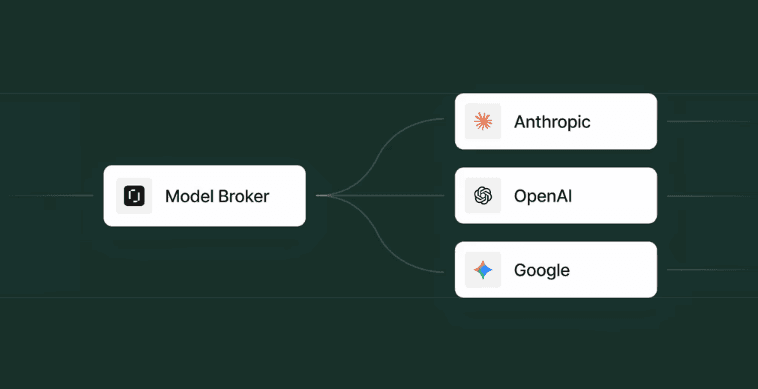
The same logic applies to the models themselves. Rogo's Model Broker routes each task across Anthropic, OpenAI, and Google, so a firm stays on the frontier without tying its future to one provider and keeps working when a model degrades. Several AI labs are building routers of their own, but each can only route within its own family of models, which is why cross-provider routing rather than routing itself is the distinction that matters.
What makes that ownership worth having is the depth of the finance work encoded in it. Rogo's agent library holds hundreds of finance agents hand-built by practitioners and has been run more than 430,000 times. Rogo's forward-deployed team builds customer-specific agents on top of that library, more than 2,450 of them with clients in a single recent week. That is the last mile of a workflow: the distance between a generic 80% and the 99% a firm can put in front of a client.
Building the rollout and partnership model
Deploying AI across a financial institution is as much a change-management problem as a technical one. A platform has to clear security review, reach people who have no spare time to learn a new tool, and still be in use once the pilot enthusiasm fades. Getting there depends on the order the rollout follows, who gets access, and how much support the vendor puts on the ground.
A durable rollout follows a practical sequence: pick the pilot, bring compliance in early, train the users, set output-review standards, then scale across teams. Skipping the compliance step or the training step is the most common way promising pilots quietly die.
Software engineering adopted AI earliest and offers the most tested playbook: give everyone tokens, let teams find the uses that work, and control cost on the back end rather than the front end.
That approach produces a power law inside a bank. In a population-level study of token consumption across Rogo's external users, the top 10% consumed roughly 52% of all tokens while the bottom half combined accounted for 6%. The top decile are the most sophisticated users, and the better response is to learn from them rather than cap their usage: codify what they have automated into agents the whole organization can run, which spreads the practice and compresses token consumption at the same time.
Rogo’s credit center can be of use here. It lets administrators monitor AI spend by team, deal, seniority, sector, and business unit, attribute it to live projects, and forecast budgets for planning cycles.
What matters most is how the tool gets rolled out. When a vendor simply hands over software and leaves users to figure it out on their own, adoption usually stalls.
Rogo takes the opposite approach: its forward-deployed team goes on-site, learns firm workflows, trains cohorts by name, and builds firm-specific agents using each client's own precedents and templates.
The results show the difference. At Baird, that approach drove 95% engagement across Global Investment Banking within a few months, a level of adoption that stalls when rollouts are software-only rather than partnership-led. The deployment has supported more than 250,000 workflow runs to date, with top power users reporting more than 20 hours saved a week.
Where AI in finance goes next
The near-term direction of AI in finance is already visible in how leading firms deploy it today. Agents will execute more of a process end to end, from sourcing the data to producing the finished deliverable. AI will sit inside the tools people already use rather than in a separate application, and continuous monitoring with a full audit trail will become ordinary.
The work itself shifts with it. Less time goes to manual assembly and formatting, and more goes to judgment, thesis development, and client relationships. Junior talent develops faster because the scaffolding is handled, and senior judgment is applied where it counts.
The larger change is that finance is gaining an entirely new system of record. What a firm accumulates is no longer only transactions and documents but the workflows, decisions, and judgment behind them, and Rogo Intelligence is where that record lives. It becomes onboarding infrastructure for each new joiner and an asset the firm keeps as people come and go.
Seeing this run on a real task is more useful than any overview. Book a demo to watch Felix run a live workflow, from a single prompt to a client-ready deliverable with every number sourced.
FAQs
How long does it take to roll out finance AI across a firm?
With a partnership-led model, firms can reach broad engagement within a few months rather than years. Working with Rogo, Baird reached 95% engagement across Global Investment Banking in that window, driven by Rogo's on-site training and firm-specific configuration rather than a self-serve software drop.
What does AI ROI typically look like in the first 6–12 months at a financial institution?
Most firms cannot cleanly quantify AI ROI yet, and that is a measurement problem rather than a returns problem. In investment banking, the unit of economic value is the transaction, and value is easiest to read the closer it sits to one. AI still works mostly at the level of individual tasks. The return on any one task is obvious, but in aggregate it scatters into increments too small to isolate. Among senior leaders deploying AI at leading investment banks, roughly 40% say it is too early to quantify and another 40% count hours saved.
No single metric settles the question, but workable frames are taking shape. One is token spend as a share of headcount spend, roughly 5% today and heading toward 20%, which asks whether people are at least that much more productive. Another is the deal break-even: how many incremental mandates, at the firm's average fee, would cover the entire AI budget. In year one, another practical step is assembling the data these frames need, most of which a firm already has: fees, wages, headcount, hours, and now token spend.
How is Rogo different from general-purpose AI tools like Claude?
Rogo is purpose-built for finance, which is what takes a deliverable from roughly right to client-ready. Its agent library holds hundreds of agents hand-built by former practitioners and tested against live companies until the output meets the standard of a leading institution. Rogo's forward-deployed team then builds custom agents on each firm's own precedents. General-purpose assistants like Claude are capable tools, and useful for quick drafting or a first pass on non-sensitive material, but they offer none of this finance-specific scaffolding.
The deeper question for a bank is what happens to the firm's own intelligence. Rogo Intelligence holds a firm's standards, precedents, and judgment as governed, permissioned data that exists independently of any foundation model. That knowledge stays owned by the firm and moves with it. Model Broker routes each task across Anthropic, OpenAI, and Google, so the firm is never tied to one AI lab, which an AI lab's own router cannot offer. Around it sit the isolated environments, MNPI separation, and audit trails a regulated institution requires.
What happens to the work a firm builds inside an AI platform if it changes models?
A change of model is survivable only when the firm's encoded work sits outside the model. Institutional knowledge encoded inside a single AI lab's memory is neither owned nor movable, so it is stranded when the firm switches providers. Rogo keeps that layer independent of any foundation model, so a firm can adopt whichever model leads next while its encoded standards, precedents, and agents carry over intact. Routing across Anthropic, OpenAI, and Google makes the switch a configuration change rather than a rebuild.
Who uses AI most at a financial institution, and what do they use it for?
Junior employees are usually assumed to be the most likely people at a bank to pick up AI. At Rogo, the pattern has run the other way: senior bankers have been among the heaviest users of the product. They use it to prep for meetings, read and write back to their CRM, test a hypothesis themselves instead of sending it down to a team, and more.
Many work this way on the move, through email or on a phone, treating Felix as another member of the team. At that level Felix works as a thought partner. It pressure-tests a deal thesis, surfaces the relevant precedents, and draws on prior interactions with a client before a meeting.
Junior employees use it for throughput on citation-heavy production work: comps and precedent transactions, model builds, the Excel and PowerPoint that carry them, and other types of work.
Across both groups, the recurring work spans the whole lifecycle rather than a few isolated steps: early research and origination, diligence, execution, and ongoing monitoring. Teams increasingly run entire deals inside Rogo instead of dipping in for one task at a time.