BlogProduct
The Value of Rogo Intelligence
How institutional knowledge can improve the efficiency and economics of financial AI

Financial work is inherently cumulative. Preparing for a meeting builds on prior conversations, researching a counterparty draws on the firm’s knowledge of the company and its management team, and executing a transaction requires synthesizing relationships, precedent work, and years of institutional knowledge scattered across people and systems.
Yet financial institutions have historically struggled to retain this knowledge. Most context remains scattered across individual inboxes and conversations, while traditional systems of record require manual input and rarely capture the connections between people, companies, and prior work. And now, even in a world where AI agents can search across firm systems, they are left to piece together fragmented firm knowledge often without the context needed to understand how it relates to the task at hand.
We built Rogo Intelligence to address this problem. Intelligence captures and structures institutional knowledge about the people, companies, and deals a firm works with, connecting information across interactions and systems to build a more complete picture of what the firm knows. Rather than reconstructing context for every task, Rogo’s agents can build on an evolving foundation of institutional intelligence.
While access to richer institutional context has the potential to improve the quality and relevance of agents’ work, we believe it could also have significant implications for the economics of financial AI. If agents can draw on knowledge that has already been assembled, they may avoid much of the redundant retrieval and processing required to complete their work, reducing both execution time and token consumption.
In this analysis, we compare the economics of Rogo Intelligence against traditional connector-based retrieval used by general chatbots, examining the agent steps, input tokens, completion time, and tokens required to execute financial tasks.
Evaluating the Economics of Intelligence
In this paper, we evaluated Rogo’s agents across roughly 8,800 tasks using a dataset designed to simulate the relationships, companies, transactions, and institutional context encountered in financial work. The evaluation spanned six weeks (August 10 to September 20, 2026) and covered common context-heavy financial workflows: counterparty research (37%), relationship follow-ups (22%), meeting preparation (20%), internal briefings (16%), and knowledge management (4%).
Using this data, we compared two approaches to accessing institutional context:
Connector-based retrieval: Agents search across connected systems to process relevant information, the approach most general-purpose AI chatbots take today
Rogo Intelligence: Agents access structured profiles containing previously assembled institutional context
To isolate the impact of each approach, we included only tasks that relied exclusively on one retrieval method. We then measured agent steps, input token consumption, completion time, and credit usage across tasks of varying complexity to understand how access to retained context affects the economics of agent execution.
What we found
A memory layer only works if the same people, companies, and deals keep coming up. And they do. Of the roughly 65,000 profiles Rogo’s agents read across the dataset, 38% were read in two or more separate conversations, and those profiles accounted for 72% of all profile reads.
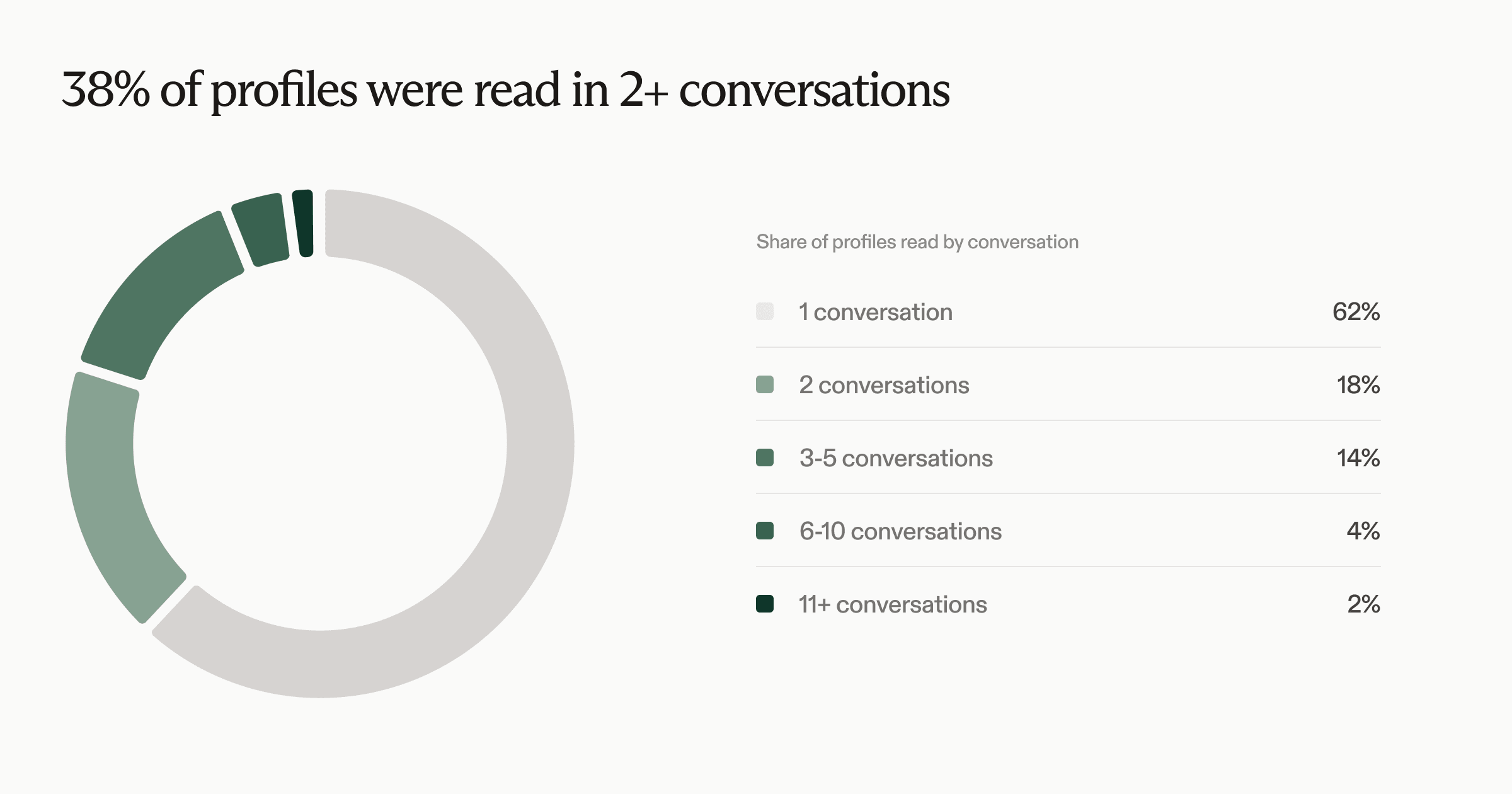
Applying these findings to finance, the opportunity becomes particularly compelling. Financial work is inherently interconnected: the same companies, transactions, and relationships inform research, client coverage, and deal execution over time. Rather than reconstructing that context for every new assignment, agents can build on what they already know.
We next measured how each approach impacted the steps, tokens, time, and credits required to complete financial tasks.
Reducing the Cost of Context
To understand the practical impact of retained context, we compared agent performance across the same financial tasks using traditional connector-based retrieval versus Rogo Intelligence. Our initial evaluations suggest that giving agents direct access to structured institutional context materially reduces the work required to complete these tasks, with improvements across three key measures:
42% fewer agent steps, declining from 12.6 to 7.3 per task.
48% fewer input tokens, declining from 1.016 million to 524,000.
22% lower latency, reducing average completion time from 129 to 100 seconds.
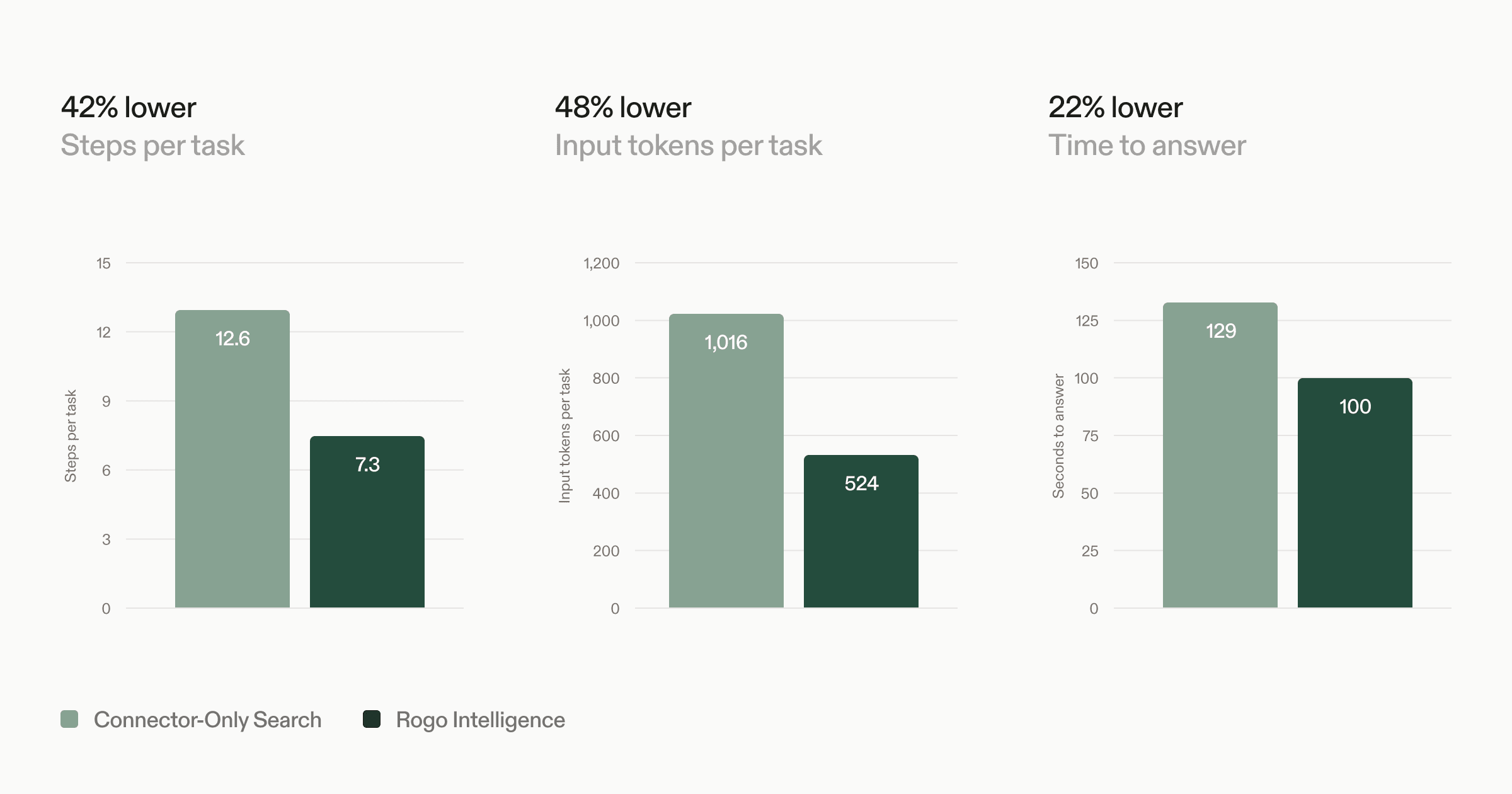
Most of the effort goes towards finding context the firm already has. Without Intelligence, an agent rebuilds the same context from scratch on every task. With connectors only, the typical relationship task took 12.6 steps (a step being one action, such as running a search in Outlook or looking up a record) versus 7.3 steps using Rogo Intelligence.
The underlying distinction is important. Retrieving information from a connected system requires more than a search. Each tool call introduces additional data that the model must read, interpret, and filter before determining what is relevant to the task. When that context has already been structured and retained in Intelligence, much of this processing can be avoided. The objective is not to reduce the reasoning an agent performs - it is to reduce the amount of work required before meaningful reasoning can begin.
The Impact on Token Consumption
These efficiency improvements also translate into lower token consumption.
Across the six weeks, average token consumption declined from 44.9 to 29.4 tokens per task, a reduction of approximately 35%.
The results were consistent across task complexity.
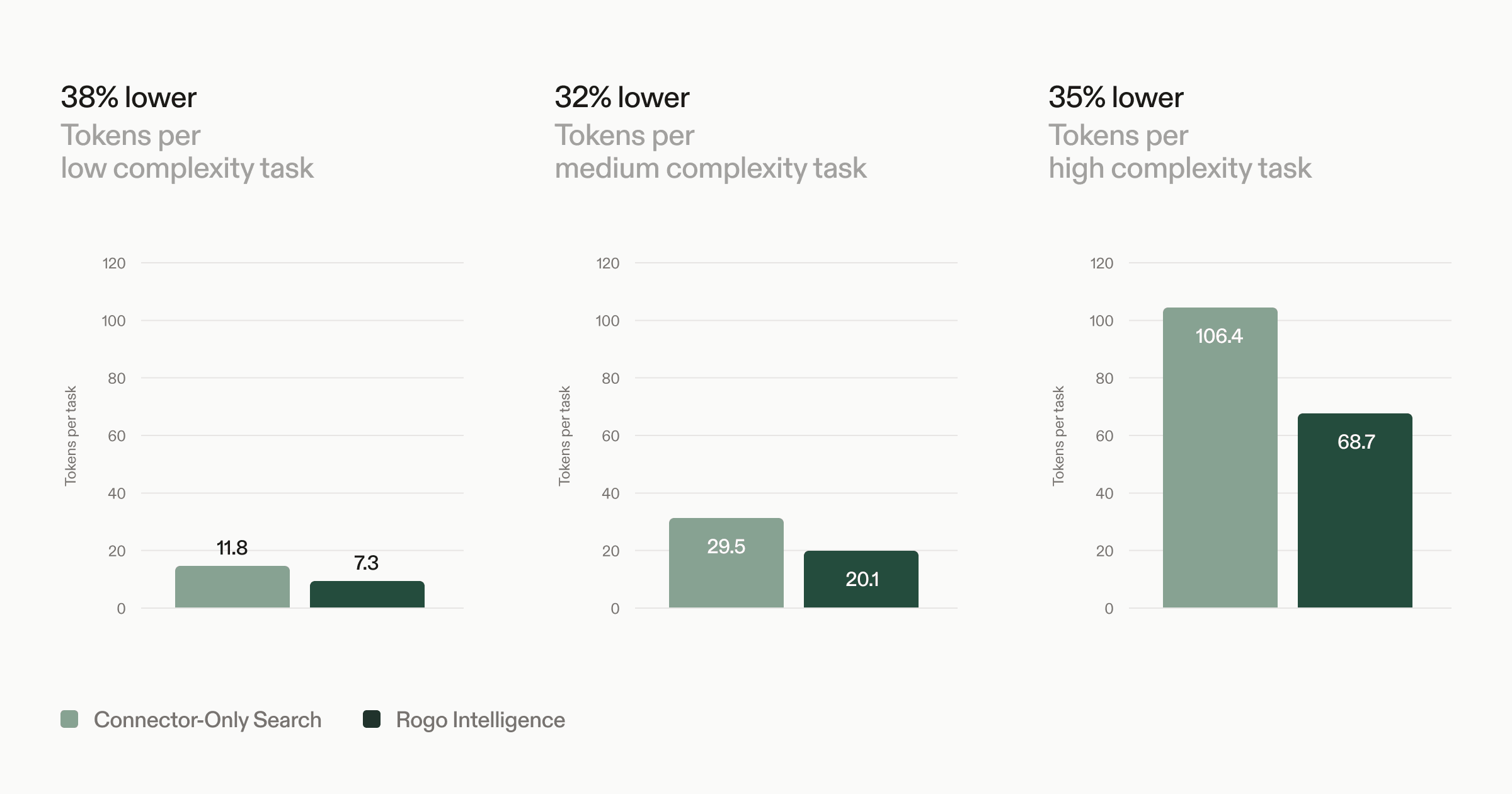
The largest absolute savings occurred in high-complexity workflows, where consumption declined from 106.4 to 68.7 tokens per task. This is particularly relevant for financial institutions, where more complex workflows often require agents to reconcile information across multiple internal systems, prior interactions, and external data sources.
The Long-Term Value of Institutional Intelligence
In this analysis, we compared agents relying on traditional connector-based retrieval with agents using Rogo Intelligence, where institutional context is structured and refreshed through passive runs. We found that access to retained intelligence materially reduces the cost of execution across 8,800 relationship-driven tasks, with approximately 35% lower token consumption, 48% fewer input tokens, and 22% lower latency.
But these results only capture the near-term economics of Intelligence at the individual agent level. We believe the more significant opportunity lies in changing how financial institutions retain, access, and build on their accumulated knowledge.
There are two dimensions of value that extend beyond the scope of this evaluation.
The first is the quality of the intelligence itself. Beyond reducing retrieval costs, structured institutional knowledge should improve the relevance and depth of the context available to agents. Whether that translates into better financial work, and under what conditions, will be the subject of future evaluations.
The second, and potentially more important, is the return on institutional knowledge itself.
Rogo Intelligence is only the beginning of making institutional knowledge reusable. Consider the implications of a financial institution that can retain the knowledge accumulated across its employees and make prior work accessible across teams. As more work is completed, Intelligence becomes an increasingly rich representation of what the firm knows, making that knowledge more valuable over time.
The opportunity extends well beyond reducing the cost of an individual AI workflow. It is about reducing the structural inefficiencies of knowledge management and increasing the return on the intellectual capital a firm has spent decades building.
We believe the greatest economic value of Intelligence is not in reducing the cost of running AI, but in fundamentally changing the return on institutional knowledge: turning decades of accumulated intellectual capital into an asset that compounds in value with every interaction, transaction, and decision.