BlogProduct
OpenAI launches GPT-6.2: What our evaluations reveal
OpenAI released GPT-6.2 Astra and GPT-6.2 Sol today, introducing updates to its flagship reasoning model and its faster, more efficient model for lighter weight tasks.
At Rogo, we work closely with leading AI labs to evaluate frontier models against the demands of financial work, using our proprietary BigFinanceBench evaluation benchmark and custom evaluations built around real financial workflows.
Here's how the latest models performed and what the results mean for finance:
1. Financial Reasoning and Artifact Generation
We evaluated both models across financial reasoning, spreadsheet generation, and presentation creation, with particular attention to Astra's performance on more complex tasks and Sol's efficiency on everyday queries.
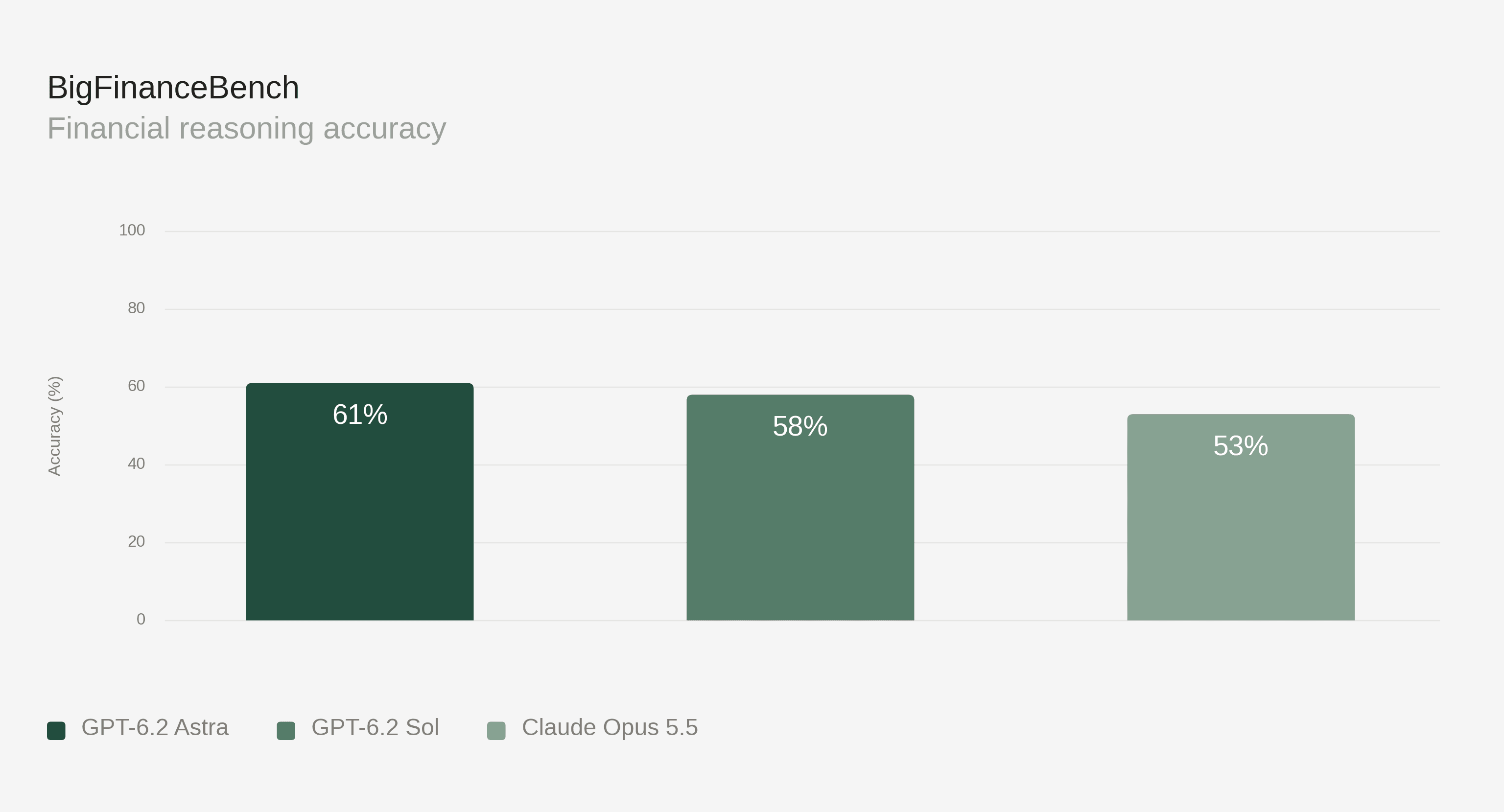
Financial accuracy: GPT-6.2 Astra achieved 61% accuracy on BigFinanceBench, outperforming Claude Opus 5.5 at 53%. GPT-6.2 Sol achieved 58%, matching GPT-6.1 Sol.
Spreadsheets: Astra produced financial models comparable in quality to Opus 5.5 while generating roughly one-third as many output tokens, reducing cost and latency.
Presentations: Opus 5.5 remained the clear leader, with blind evaluators preferring its decks in 94.8% of comparisons.
Speed and efficiency: At medium reasoning effort, GPT-6.2 Sol returned answers 15% faster than GPT-6.1 Sol while consuming 13% fewer input tokens, without sacrificing accuracy.
2. The Next Frontier: Evaluating Context and Continuous Work
Financial work is rarely confined to a single question, spreadsheet, or presentation. As Rogo customers connect more of their first-party data and build institutional context through Rogo Intelligence, we are increasingly focused on evaluating how models perform across longer-running workflows.
In practice, this means correctly identifying where new information is relevant across different workflows, whether an incoming email, a news event, or an M&A rumor that changes a partner or MD's next steps on a live transaction.
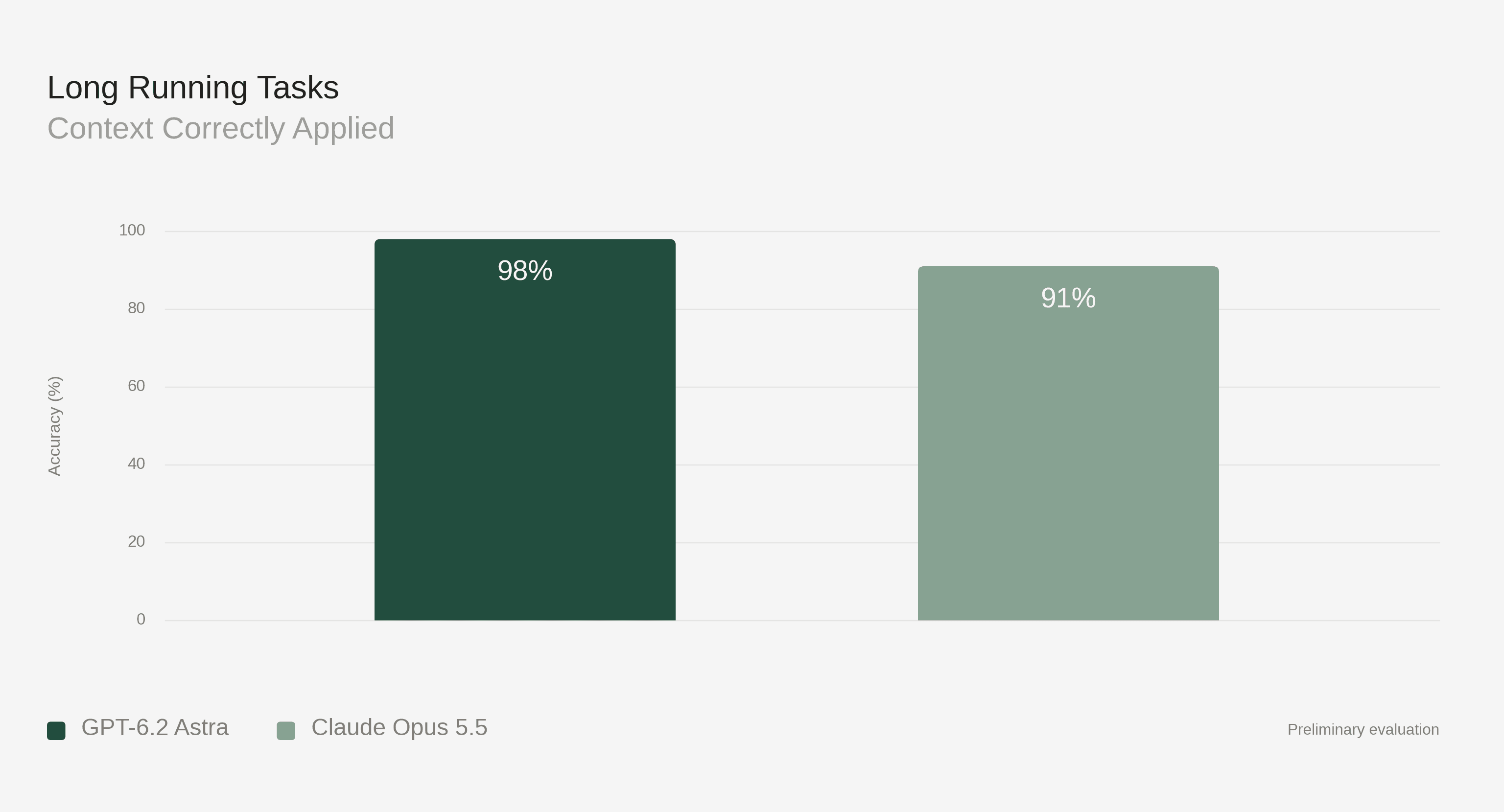
We've begun exploring this through early-stage evaluations simulating a financial professional's workday, with more than 50 specialized agents managing concurrent tasks. We then introduce a stream of new events and evaluate whether the model correctly routes each development to the agent already responsible for that work.
In this preliminary evaluation, GPT-6.2 Astra correctly routed 98% of events, compared with 91% for Claude Opus 5.5.
As bankers and investors increasingly execute live deal work in Rogo, the ability to maintain context and coordinate work across multiple agents becomes an increasingly important measure of model performance.
3. What This Means for Financial Professionals Using Rogo
Our results reinforce that model performance remains highly dependent on the underlying task.
GPT-6.2 Astra leads on precise financial questions and shows particular promise for longer-running, context-dependent workflows. Claude Opus 5.5 remains stronger for presentation generation and in-depth research. For everyday tasks, GPT-6.2 Sol offers existing Sol users equivalent accuracy with lower latency and fewer tokens.
At Rogo, we abstract away these decisions. We've built a bespoke fusion of models, continuously fine-tuned as new AI advances emerge, to match each financial workflow with the model best suited to execute it. We're excited to bring these latest advancements to the suite of agents our customers rely on every day.